Tuesday morning in early January, 2018 came early for me. We were supposed to muster at 6:15 am. After waking half-a-dozen times to check the clock, each time 30 minutes later than the last, I finally decided to get up and write a little. It was around 5:30.
I made my way into the beautiful kitchen / dining area of his villa and got myself a half glass of the best orange juice I’d ever had. Checking the supplies, I found bagels and cream cheese. I had just finished my bagel, when Mark came up from the ground level. I suspected he had the same problem with sleep I had.
He too, had a bagel and fixed two more, for Will and Jon, figuring it would be good to have something in their stomach with the boat-ride we were about to experience. At about 6:20, the two zombies wandered into Mark’s home. Everyone was excited, but still half asleep.
Being the worry-wart I am, I wondered if there would be a car to take us to the dock. Mark seemed totally unconcerned, trusting Brendalee to deliver as promised. He had the experience, so I just relaxed, as best I could. At precisely 6:30, we wandered out of the front of his villa and within seconds, sure enough, the gate standing 30 yards away, opened as our transportation had arrived.
We all dragged our bodies into the van. Mark gave instructions to the driver and we were off. To go left on the one (and only) highway into and out of Cabo, you had to go right for a mile-and-a-half, then up and over the highway making a U-turn. The bad thing was, there’s a bridge for U-turns about 200 yards to the left, but the road to get to it was one-way, going the wrong way.
In the early morning, it was still dark and nothing was going on. We made our way quickly and quietly into town, then through the various alley-ways leading to the docks. Mark repeated his instructions several times before we reached our designation, the North side of the dock. The driver told us to walk past the barricades for 50 yards and we’d find someone to help.
Jon was supposed to be our interpreter, but it turned out he knew twice as much Spanish as I did and I knew none. You figure it out. The first locals we met, were a group of shady-looking characters who tried to entice us to let them take us out. After several minutes of trying to understand one another, we finally found one who told us to proceed another 100 yards forward to the dock itself. Four sleepy, white guys wandering along, we stopped in front of a local coffee café where Mark explained what or who we are looking for. Amazingly, we are at the right place. We were told to just wait until our guy arrived. Fifteen minutes ahead of schedule, we stood around and sat, just killing time.
Between the shoreline and the boats, was ten or fifteen feet of water and the wooden-dock to which the boats were tied. There appeared to be only one ramp leading from the shore to the dock. A large gate prevented anyone from getting on the dock itself. The eight-foot-high, steel gate appeared to be locked, with one man standing guard on the shore side. Being so sleepy, it was hard for me to tell if the gate was intended to keep the fishermen in, or the tourist out. Either way, it prevented us from walking on the dock itself.
Several parties file by and enter the gated dock area with their guides. I couldn’t help but wonder what the morning would bring. Would it be like the morning of Mark’s wedding in the Bahama’s where we caught several big fish, or, like cruising for hours around Hawaii without a single fish to show for it. I prayed it would be the former. Mark went to a lot of trouble and expense for this trip, as a Christmas present for me. We didn’t want to come back empty handed. Still, that’s a big ocean out there, and it’s a wonder any fish are ever caught at any time.
After ten minutes or so, Mark recognized the guy from the yacht club he set us up with. They exchange greetings and we passed through the gates. We waited on the dock (boat side of the gate) while the guide went to the end of the dock to talk to a captain. He motioned us toward him and we walked past several boats of all sizes. Handshakes were exchanged, just behind the last boat on the dock. Mark and the guys got into the boat. Everybody seemed concerned the old man might somehow fall into the water getting in, but I surprise them all (and myself) by stepping right in.
We met the captain who was about 5’9” with a medium build. His English was limited, but thankfully, not as limited as our Spanish. The mate was about 5’6” with a slight build and dressed as though he knew it was going to be colder on the water than we thought. I wondered if I should have worn more. My shorts, tee shirt and lucky Bama red shirt was all I had on. I brought a pull-over and decided I’d put it on, after looking at the mate. Before we left the waters of the dock, the mate had his head and part of his face covered with some stretchy material. It reminded me of a bank robber, still dark, 10-15 minutes before sunrise. I hoped he was just more cold-blooded than most people.
We idled out of the harbor and went about a quarter mile into the bay. It was very dark on the water as we stopped. If I was going to die, I wanted it to be out in the ocean, not in the bay where my body would just float around for a couple of day. Get me out where I could be eaten. At least my mind was active at that time.
Our boat (Joana) was what I would call “medium size” with a cabin down, the main fishing area and the raised captain’s nest area above. We sat still in the water while dozens of other boats of all sizes made their way out into the dark. For five or six minutes, we didn’t know what was going on, until a simple fifteen-foot boat pulled up beside us. The captain came down to the side where the boat was, chattering in Spanish. He must have been negotiating or catching up on the latest harbor news with the guys in the boat. The mate used a light on his phone, to examine the live-well counting the number of fish he still had from his last trip. He stuck his hands into the well and moved some of the fish around to get a good tally.
With inventory completed, they determined how many additional bait fish they would need. We ended up getting about 4 or 5. I knew they used lures as well, so I really couldn’t tell how many we might need. My mind told me more was better however; this didn’t seem like a lot. After chattering some more and securing some ice (or dry ice) the mate stored in a hold container, the flat boat pushed off into the night, probably to sell bait to other boats.
We started up again and headed out to sea. The sun hasn’t risen yet, but it’s beginning to lighten up. Looking around, there must be two-or-three dozen boats all within a quarter mile around us. As we headed out, the mate began his preparation. He sticks his hand into the live-well and shuffles the fish around until he finds the one that suits him. The fish is long and skinny, obviously made for fast swimming to avoid bigger fish.
The sides of the ivory boat on the fishing deck are about two or two-and-a-half feet tall. Along the sides, there is about a six-inch top ledge and an eight or twelve-inch top ledge across the entire back. Outside the back of the boat is a ledge, just above the water-line that’s maybe two-and-a-half feet wide. The motor is under this back ledge. We’ll soon learn that this back ledge is helpful for the mate to get around.
On both sides of the boat, there is a rod near the corner and one about five or six-feet further toward the front. The rod holders are very secure, they don’t want to lose those babies. Just behind the rod toward the front, extending away from the boat by about six feet, is a tall skinny pole that extends above the water by about 10-12 feet. A simple, but effective, pully system allows the line of the rod nearest the pully to extend its line up and away from the boat.
Across the boat, at the captain’s level are several rod holders, perhaps a foot away from one another. We’ll soon have two more rods extending from these center holders, for a total of six lines in the water.
There is a “fisherman’s chair” on either side of the boat near the back corners. They’re heavy plastic, they swivel and of course, have a rod holder that will be straddled while fighting to land a fish. The sides and back of the boat is close enough to leverage your feet against, when pulling back on the rod. Jon plopped in the right (looking toward the back of the boat) and Mark instructed me to sit in the left one.
It’s getting lighter now and the mate is setting up the lines. With the boat traveling forward, he measures how much line he wants out, letting the boat’s forward motion do the rest. He’s got four lures on lines as he prepares the live (soon to be dead) bait.
Very meticulously, he takes one of his several towels (about 12×16 inches), wets it, wrings it out, then folds in on top of the back ledge. The baitfish he’s selected wiggles a little but it’s no match for his strong hands. Holding it down with his left hand, he produces an eight-inch-long wire that resembles a knitting needle. I’m curious to see what happens next.
The live fish becomes bait when he inserts his needle into the spine of the fish moving it in and out, from back to front, until the fish is limp. There is little blood as he punctures the brain. Next, with the precision of a surgeon, he slices the fish’s underneath from just behind the gills all the way to the back, throwing whatever falls out into the sea. Then the interesting part begins.
He pops the eyes out with his thumbs and holds it up to reveal a vacant passageway where the eye used to be. Light can be seen from side to side through the sockets. The bait is now ready to accept the payload.
He measures out a precise length of lead-line, doubles it on itself and picks up an oblong lead weight about an inch in diameter. He makes some fancy knots and attaches the business portion (the hook) to the weight and leader. When he’s done, he’s got a device that he pushes into the cavity of the bait-fish, pulling the leader line through the mouth and eye sockets. He wraps the leader around the closed mouth of the fish several times, thus making a live (dead) lure ready to be sent into the ocean. He put one of these on each of the rod in the rear.
Thirty minutes into the trip, he retrieves one of the bait lures that has been bitten off, just behind the hook. “Sea lion”, he says without emotion. The bite is reminiscent of Jaws, rugged, but clean. Without any visible emotion, he follows the procedure again to get the line back into the ocean.
After preparing each hook, he carefully washes down the rear ledge and boat with seawater and wipes the ledge clean with his towel, then rinses it out to be ready for its next use. I’m amazed with the precision he has with the knife, although when it’s been done as many times as he has completed it, it’s not too surprising. The clean-up also keeps the smell to nothing as we head out to sea paralleling the shoreline.
We circle the landmark Arch extending into the ocean pointing South and head West, still parallel to the shoreline. All along the shore are vacation villas just beginning to turn their lights on. Some are grouped together as units, some are huge with what looks like twenty thousand square feet, or more. They dot the mountainside as we make our way out to sea.
Back to the East, we can watch the sunrise with beautiful shades of red and orange cascading on the ocean and coloring the long thin clouds. I take my sunglasses off my American University ball cap and enjoy the view with the steady rhythm of the motor and ocean waves pounding against the boat.
As the sun rises higher, I begin to worry if feeding the sea lions are the only action we’ll see today, reminiscent of Hawaii.
About half an hour after sunrise, it’s bright and sunny. It also begins to warm-up. Toward the East we can see several boats that appear to be going due East away from us. I know about where our resort is (because of its water tower) and it’s as if it’s there where they’re heading. A good quarter mile, or maybe farther out (it’s very difficult to gage distance on the sea), I can see a couple of what looks like narrow white sails extend ten or fifteen feet above the water line. That seems to be where the boats are heading.
Then it makes sense, as a giant whale comes out of the water and lands on its back. The white sails are their fins. We all watch for several minutes and can clearly make-out the whale(s) even as they appear fairly small based on their distance from us.
A short while later, the mate scurries down from the captain’s level and grabs one of the baited rods. He yanks hard three or four times and reels quickly as he sets the hook. The rod is on the right side and after setting the hook, the mate offers the rod to Jon. Jon sets the rod in its place between his legs while sitting in the chair and begins to reel it in. He has no problem with it and soon the mate grabs the line and pulls a two-foot, silver fish into the boat. Everybody’s happy as Jon holds the fish for pictures. The mate then takes the fish and puts it into the live-well. At least we won’t be shut-out.
Maybe ten or fifteen minutes later, the mate is jerking to set the hook on another fish. As the green fish breaks water, the mate follows Mark’s instructions and gives the rod to me. As if landing a really big fish, I sit in the chair and pull back, then reel while pointing the tip of the rod toward the fish in the water. It’s easy to keep the tension on the line as the fish fights my efforts. It takes a few minutes reeling, as the mate makes his way out onto the platform.
He holds the line in one hand guiding the fish toward the boat, then he hooks the fish with his gaffing-pole. The fish goes limp when he uses his needle on it, as he did the bait. He then hands the 3-foot long fish off to me. The fish has a local name, but its species is Mahi-Mahi. It’s a beautiful dark green on top, moving to a light green and finally yellow/gold bottom. The dorsal fin is almost as high as the fish is tall and begins just behind a dominant forehead other fish don’t seem to have. I couldn’t be happier. This is the best eating fish I know of. I hold my catch and smile for pictures before the mate puts the fish into the hold container kept cold with ice.
Everybody’s happy as we continue moving out further to sea, still parallel to the shoreline. The volume of homes and villas diminish as we proceed along the shore until all are gone, with just sandy beaches and brown hills turning into brown mountains at the tip of the Baja mountain range. As always when fishing, we’ve hit the dead spot. We’ve been on the water for an hour-and-a-half and we’re still heading out, but more toward the ocean now, angling away from the beach.
Suddenly, the mate comes down to our deck pretty excited. Well, let’s just say he came down to our deck. He reels in one of the bait lines and takes it toward the front deck over the cabin. I don’t know how they did it, but we think they’ve found some fish.
The captain begins to crisscross the ocean, while the mate throws the bait into the sea. I don’t know what’s going on, but the adrenaline is beginning to flow. After a few minutes of jabbering and pointing, I can see some very narrow tailfins popping up and down in the water. There looks to be maybe half a dozen, but it’s really hard to tell. The fins look like long black feathers, tall skinny and shooting up and down. I can’t see a fish attached to the fins, but they extend above the water by a couple of feet, then disappear in an instant. All I know for sure is that the mate seems intent on what he’s doing.
I didn’t see him jerk to set the hook, but when he came back to our deck in back, we could all see he was letting out line, or should I say, line was moving out from the reel whether he was letting it or not. Mark hollered at Will to take the rod. He had already been setting in the left seat. With the rod in the holder, the mate, Mark, and I began to reel in the other lines to avoid getting them tangled up.
Will was just getting settled into the chair, straddling the rod and beginning his pull and reel rhythm. We were all excited but didn’t know what kind of fish he had. Between fifty and seventy-five yards out to the left and back of the boat, a large beautiful blue marlin broke water. Shaking his head and exposing his gills, he was trying to get free as we all yelled with excitement. Over the course of the next five or ten minutes, he came out of the water three or four more times. Walking across the water on his tail, as Will’s strong arms, back, and shoulders were reeling him in.
Now you must understand, only Mark, twenty-six years ago, had ever fought a marlin. For Will, he had a rod in his hands and on the other end of the line was a gorgeous fish. It didn’t seem too complicated, the strongest guy in the boat was going to reel in the big fish. What could go wrong?
After another five minutes or so, Will’s shoulders sagged as began reeling in the line very rapidly. “He’s off”. His disappointment could be seen in the bow of his back and neck. “He’s off”. “Are you sure? Maybe he’s just running toward us.” “No, he’s off.”
The mate came to stand behind Will and reached for the limp line. Sure enough, the fish had gotten free. The line had snapped. At that point we learned, it took more than brute force to land a marlin. Too bad we didn’t know it going into the battle.
But for five or ten minutes, we all had an exciting view of a beautiful fish as he tried desperately to get free. I wished there was something to say to Will, but there wasn’t. Actually, Will was taking it better than I was. I knew this opportunity didn’t happen very often in a lifetime. The problem was, at that time, I didn’t know what went wrong.
For thirty minutes or so, the captain continued to crisscrossed the ocean. I was going nuts pointing to other tail-fins off to both our left and right. Then there was a prominent dorsal fin ten feet or so from the boat. I was excited until the mate said “dolphin”.
The mate had made another live lure and secured it to a new leader-line. Back up to the front of the boat he went as we hollered with every skinny fin we saw. He would have had to been deaf not to hear me, I was excited, but he was concentrating on what he was doing.
Back and forth we went, re-tracing our path several times for twenty or thirty minutes. Then the mate came back, to the back with the rod stretching out toward the sea. It wasn’t hard to tell he had something as Mark began to look around for who was to take the rod.
I shouted for him to sit in the left chair and get his fish in the boat. None of us could tell what was happening, because the fish didn’t break water, but with the line leaving the reel rapidly, we were all excited.
“What is it?” Something came out of the mate’s mouth, but I couldn’t understand. “What’s he got?” I got the same answer, but he added “big”. Determined not to have the same outcome Will had, I encouraged the mate to assist Mark in his fight with the fish, “He needs to land this fish for a big tip“, emphasizing “big tip“. The mate positioned himself next to Mark, along the back.
I couldn’t tell what he was telling him, other than to hear “three”, telling Mark to only reel in, three turns of the reel. Or “run”, letting Mark know the fish was running and for him to not do anything. During one “run”, Mark and I looked down at the reel and he asked, “Are we going to run out of line?”. The mate didn’t seem concerned.
After reeling and watching him “run” for several minutes, the mate began to shout at the captain. The boat started moving backwards as water tried to reach the deck. After another several minutes, the captain tried to head toward the fish. I asked Mark how he was doing as he huffed and puffed, just a little. He was reeling in most of the time, except when the mate told him to let up, but he and I knew, he was losing ground. The fish was taking out more than Mark was pulling in. Little did I know, we were only in the first inning.
I couldn’t figure out why Will’s fish broke water so often in such a short period of time. Mark had been working this fish for ten or fifteen minutes and he hadn’t broken water yet. Then it made a half-hearted attempt, nothing like Will’s walking on its tail.
Mark’s right hand was starting to feel the pressure of the reel. I’m sure it was beginning to burn and he may have been thinking about a blister, for half a second anyway.
At the twenty-minute mark, I began to worry he might lose it. It would be a real shame to lose it after battling for so long and hard. But the mate was working Mark hard, just like Mark was working the fish.
At thirty-minutes, the fish tried another tactic. He came toward the boat and Mark was able to gain a lot of line. Five minutes later he appeared to go under the boat. The captain and mate chattered at one another. I was sure this was not good as he tried maneuvering the boat to keep it from cutting the line with the propeller or such.
At forty-minutes we could see the shadow of the fish near the boat. Exhausted, it didn’t have much fight left. Just about then, I could see the splice where the leader line and the regular line met. Crap, I thought. The mate has got to get that splice on the reel before something happens. I tried to point that out, but to no avail.
Then boom, another “run” and I watched the line go out as Mark and I just looked down at the spinning reel. There was nothing to do but wait. I wish I had known to do this with Will’s fish. Two marlins would have been incredible. Then it hit me again, we didn’t have this one in yet.
At forty-five-minutes we could once again see the splice. This time the fish was moving, but not running. The captain came down from his nest with a wooden blackjack of sorts, maybe two feet long and two inches in diameter. The mate was already outside the boat on the platform with the gaff-rod. The captain had a towel in his left hand and the club in his right. Mark was holding fast, waiting for further instructions.
The mate reached up with his left hand and grabbed the leader. At just the right moment, into the water went the gaff-hook as the mate leveraged the length of the pole to sink the hook deep into the side of the fish.
As if by instinct and exactly at the same moment, the captain grabbed the sword-like beak of the fish with his toweled left hand, pulled the head toward the side of the boat where he proceeded to give the fish a drubbing with the club. Eight or ten times in about three seconds, the captain wailed on the poor fish. As it went limp, the captain moved it back to the platform where the mate was standing, never losing his grip on the toweled beak.
Still holding on to the gaff-rod, the mate lifted the fish and put his arm around the fish, just in front of the tail. The fish didn’t move a muscle.
The mate was much stronger than I had given him credit for, to be able to lift the fish, nearly by himself. The captain began moving people out of his way and telling Mark to get ready to accept his catch. With his butt on the back ledge, Mark extended both arms while the captain and mate centered and laid the fish in his arms.
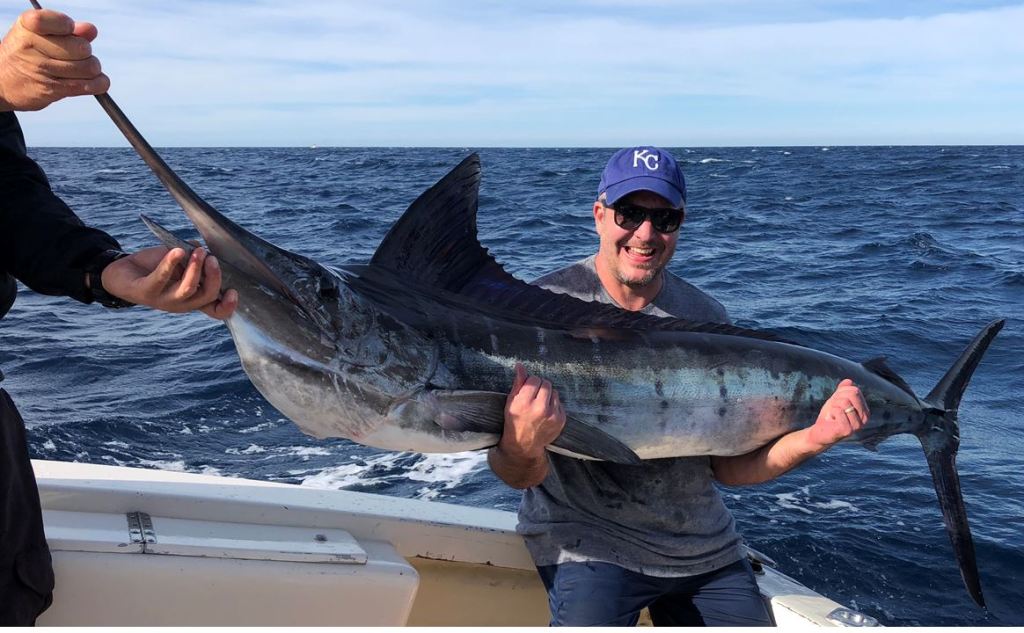
Mark looked happy, somewhat stunned, and tired as we took pictures. None of us, Mark included, could take our eyes off the fish Mark had fought for nearly an hour. It was now either brain dead or fully dead from his beating. After all the pictures had been taken, they laid the fish across the width of the boat. From the end of his beak to the end of his tail, he was only about three inches shorter than the boat-width.
We all touched it. When we pulled the dorsal fin up, two long skinny guiding fins came out from under his stomach. It wasn’t slimy or slick, but more like a sandpaper or rough textured. We all watched it in amazement. A couple of times, it looked like it was trying to breathe, but with the beating it took, there just wasn’t any way.
As the fish laid on the deck of the boat, the mate began to reset lines, back into the sea. We appeared to be going slower now, still crisscrossing our way back toward the dock. Inside the lower cabin, there was a book of fish, put out by the taxidermy stores. I looked Mark’s fish up and it looked like it was a mix between a striped and black marlin. Will’s fish, from what we could see, was more blue in color. Mark’s was more silver, grey and black with dark two-inch wide stripes extending straight down from its back.
From the tip of its sharp pointed beak, to the end of its strong skinny tailfins, this fish was built to run, fast, very fast. It was as close to an arrow as one could imagine. Firm and streamline, nothing but muscle, it was easy to see how it would dart in the ocean while changing directions on a dime. The dorsal fin was more streamline than the sailfish hanging on the walls in barbershops I remembered as a kid. This fish shined in the light of day without being slimy or slick. It was simply beautiful.
I searched for more skinny tail fins, as we headed back, but to no avail. We were all stunned with the fish laying in front of us. And although we still had lines out, we were speeding up a little on our return. When we got within twenty minutes of the dock, the mate fetched my fish from his storage container.
He laid the fish on top of one of his towels on the back ledge of the boat. Like a surgeon, he pierced the fish from front to back, creating an outline of the section he was about to filet. He stuck the knife under the skin just enough to get a piece of skin to hold. Then he pulled the skin off revealing the meat we wanted to keep. With the skeleton running up and down the fish from top to bottom, he inserted his knife, moving front to back with the knife tip following the bumps of the spine.
He wiped the blood off with a second towel, cut the meat to size and put it in a baggie. He sat the baggie aside and repeated the process on the other side. Throwing the remains into the sea, he handed the plastic bag filled with meat to Mark, who put it in his container holding our water.
Cleaning off the ledge and rinsing out his towels, he began to bring in the lines preparing for the harbor as we approached the landmark arch of Cabo. Out of nowhere, or so it seemed, a huge sea lion invited himself up on our back ledge. He begged for some scraps, but not getting any, slipped gracefully back into the sea.
The mate, having taken care of the rods, hoisted three flags to show the world what we had caught. I asked Mark why the mate didn’t fix the fish Jon caught and was told, “that’s now bait”. As we passed several boats, including a cruise boat, I could see them looking at our flags and pointing. It was a great feeling.
The captain maneuvered the boat into its place with its rear meeting the dock. Ten yards away and six or seven feet higher than the water line, the tourist began to gather to see what we had caught.
We all posed for pictures before laying the marlin on its side, on the boat’s back ledge. This time the captain was going to do the honors. Mark had talked with them and told them how many were in our party back at the villa. Accordingly, the captain cut his outline of a section on one side of the fish, maybe 10×18 inches long. The captain was having trouble separating the skin from the meat. The mate took the knife and gave him a place to grab from. He pulled hard several times separating the two. A few minutes later, Mark had a couple of additional bags of meat put away in his cooler.
There were smiles and handshakes all around as we gathered ourselves and our prize to begin heading for the gate. Once there, a little guy demanded payment to exit the dock area. Mark let him know, in no uncertain terms, he’d paid to get in and wasn’t paying again to get out. Once the gatekeeper understood he was not going to be able to extort any additional money from the group, he reluctantly opened the gate.
Several tourists who had been watching, congratulated us as we made our way along the shoreline, heading for our ride back to the villa. After taking a short detour, Mark decided to get a van, instead of waiting for the courtesy shuttle.
During the ride back to the villa, I suddenly discovered that I was really tired. The early morning and the excitement of the trip were just settling in on me. I was happy. I was very happy. We were heading home with pictures and an experience likely not to be repeated during my lifetime. I was sad we didn’t get Will’s fish into the boat, but happy Mark was able to land his. All in all, it had been an exciting and eventful day.
When we reached the villa, the guys went back to their place and after a brief description of the day’s events to Linda, I was exhausted. “I’m going into the bedroom and rest my old eyes for a minute.” My brief sleep was filled with the wonderful memories of the morning, the fish and being with the guys. For an old man, what more could you ask for.
Thanks, son, for the trip and the memories. Fond memories are all that’s left at this stage of my life and you’ve just added greatly to the collection.
Love, dad.
 BillDeFoor